

SEO in 2025 is changing faster than ever and everyone seems to be chasing the next big ranking trick. But hold on. It turns out that backlinks now contribute about 40 percent to your ranking potential which is huge. And yet the real surprise is that it is not just about collecting links or stuffing keywords anymore. The winning formula blends expert-level content, a website that loads instantly, and genuine authority—leaving old-school hacks in the dust.
Table of Contents
- Core Seo Ranking Factors For 2025
- Content Quality And User Experience Importance
- Technical Seo: Site Speed And Structure
- Link Building And E-A-T Best Practices
Quick Summary
| Takeaway | Explanation |
| Content Quality is Crucial | Prioritize developing in-depth, original content that addresses user needs effectively. |
| Technical SEO Enhancements Matter | Focus on site speed, mobile optimization, and structure for better rankings. |
| Quality Over Quantity in Backlinks | Aim for authoritative, contextually relevant backlinks instead of just increasing numbers. |
| E-E-A-T Principles are Essential | Demonstrate expertise and trustworthiness in your content to improve rankings. |
| Optimize for SERP Features | Structure content to qualify for enhanced search result features that boost engagement. |
Core SEO Ranking Factors for 2025
Searching for effective SEO strategies requires understanding the core ranking factors that influence search engine performance. As digital landscapes evolve, search engines continuously refine their algorithms to deliver the most relevant and valuable content to users.
Content Quality Remains Supreme
Content quality continues to be the foundational element of SEO ranking factors in 2025. Google’s helpful content system emphasizes creating comprehensive, user-focused content that genuinely addresses search intent. SEO consultants must prioritize developing in-depth, original content that provides clear value to readers.
According to Backlinko’s comprehensive analysis, high-quality content involves more than just keyword placement. It requires understanding user needs, presenting information authoritatively, and maintaining exceptional readability. Successful content demonstrates expertise, addresses user questions comprehensively, and maintains a natural, engaging tone.
Technical SEO and User Experience
Technical optimization has become increasingly critical in 2025. Search engines now evaluate websites holistically, considering factors beyond traditional keyword optimization. Core Web Vitals remain a significant ranking signal, measuring page loading speed, interactivity, and visual stability.
Mobile optimization is no longer optional. With over 60% of internet traffic coming from mobile devices, websites must provide seamless experiences across all screen sizes. This means responsive design, fast loading times, and intuitive navigation are essential for maintaining competitive search rankings.
Backlinks and Authority Signals
Backlinks continue to serve as powerful authority indicators for search engines. AdLift’s analysis reveals that quality backlinks contribute approximately 40% to ranking potential. However, the emphasis has shifted from quantity to quality and contextual relevance.
Modern link-building strategies focus on earning authoritative, contextually appropriate backlinks from reputable websites within your industry. Search engines now assess not just the number of backlinks, but their origin, relevance, and the overall linking website’s credibility.
For SEO consultants aiming to stay ahead, understanding these core ranking factors is crucial. Learn more about optimizing your keyword strategy to navigate the complex SEO landscape of 2025 effectively. Successful optimization requires a holistic approach that balances technical excellence, compelling content, and strategic link acquisition.
Content Quality and User Experience Importance
In the rapidly evolving digital ecosystem, content quality and user experience have become paramount for successful SEO strategies. Search engines increasingly prioritize websites that deliver exceptional value and seamless interaction for users.
Evaluating Content Through E-E-A-T Principles
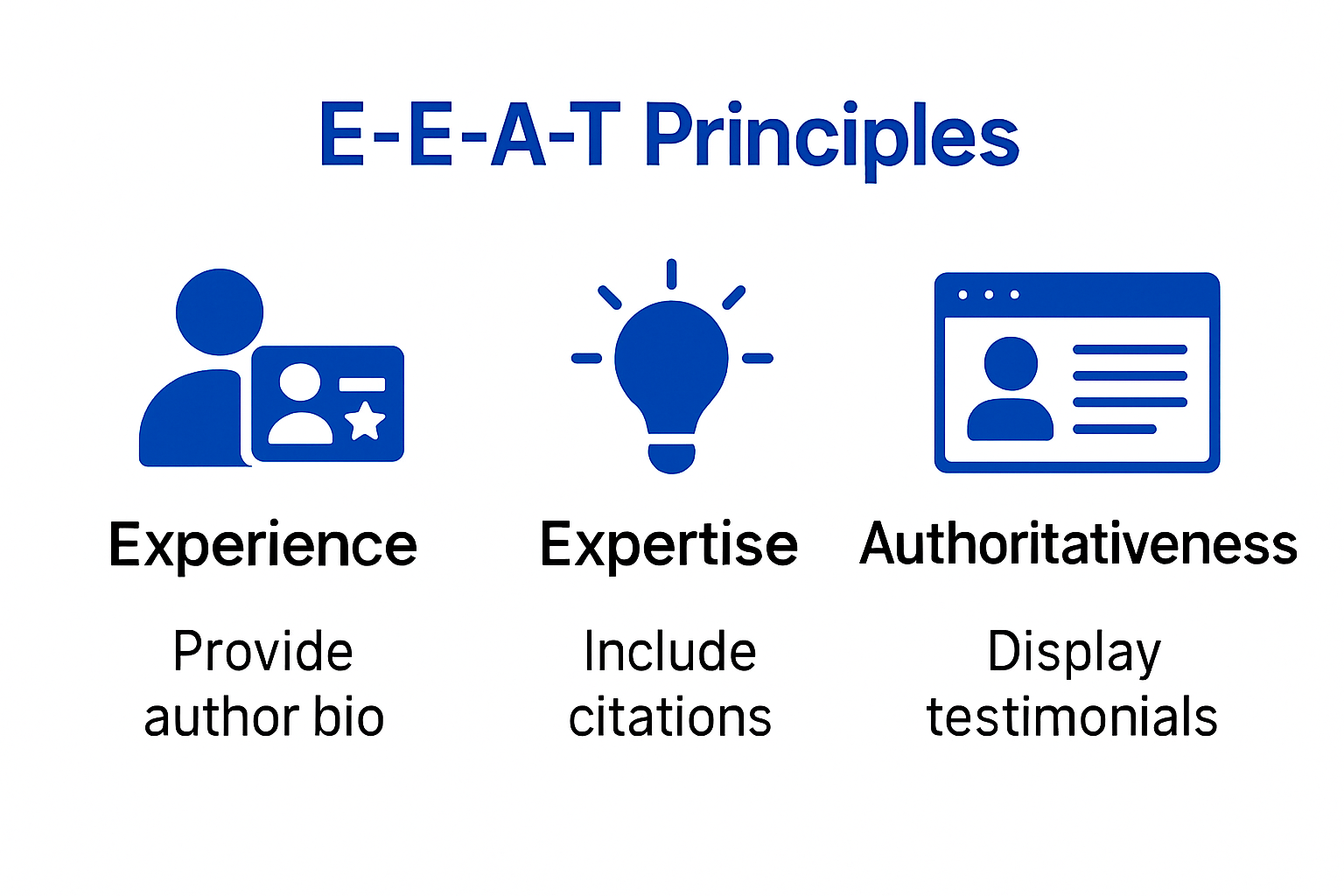
Google’s quality assessment framework has expanded to include Experience, Expertise, Authoritativeness, and Trustworthiness (E-E-A-T). According to Lumar’s comprehensive analysis, these principles are now critical for determining content ranking potential. Websites must demonstrate genuine expertise through content that reflects real-world knowledge and provides substantive insights.
Creating content that genuinely helps users requires going beyond surface-level information. Writers must draw from authentic experiences, showcase deep understanding of the subject matter, and present information in a credible, transparent manner. This means including personal insights, citing authoritative sources, and maintaining a consistent track record of high-quality content across the entire website.
SERP Features and User Engagement
Modern search results are no longer simple text listings. Research from academic studies reveals that SERP features like knowledge panels, media galleries, and rich snippets significantly influence user click-through rates and engagement. These dynamic elements provide users with immediate information, making the search experience more interactive and informative.
SEO consultants must optimize content to not just rank high, but to be eligible for these enhanced SERP features. This involves structuring content with clear headings, using schema markup, and creating comprehensive, easily digestible information that search engines can extract and display prominently.
Technical Aspects of User Experience
User experience extends beyond content quality into technical performance. Search Engine Land’s research emphasizes that Core Web Vitals remain a critical ranking factor. Websites must focus on loading speed, interactivity, and visual stability to provide a smooth user journey.
Mobile optimization is no longer optional but mandatory. With increasing mobile internet usage, websites must deliver responsive designs that adapt seamlessly across different devices and screen sizes. This means implementing fluid layouts, optimizing images, and ensuring that navigation remains intuitive regardless of the device being used.
Discover advanced strategies for improving your website’s content quality and stay ahead in the competitive SEO landscape of 2025. Success requires a holistic approach that combines compelling content, technical excellence, and a deep understanding of user needs.
Technical SEO: Site Speed and Structure
Technical SEO has evolved from a background optimization strategy to a critical ranking determinant in 2025. Search engines now scrutinize website infrastructure with unprecedented depth, making site speed and structural integrity fundamental to search performance.
Performance Optimization Fundamentals
Comprehensive research from academic sources reveals that website technical structure directly correlates with search visibility. Modern search algorithms evaluate multiple performance metrics simultaneously, assessing how quickly and efficiently websites deliver content to users.
Optimizing site speed requires a multifaceted approach. This includes minimizing server response times, leveraging browser caching, compressing images, and reducing unnecessary code. Websites must achieve loading times under two seconds to remain competitive in search rankings. Advanced techniques like implementing content delivery networks (CDNs) and using next-generation image formats can significantly accelerate page performance.
Below is a summary table outlining key technical performance optimization strategies and their purposes.
| Optimization Strategy | Purpose |
| Minimize server response time | Reduces delay before a page begins loading |
| Implement browser caching | Speeds up repeat visits by storing files locally |
| Compress images | Decreases page size for faster load times |
| Reduce unnecessary code | Improves parsing and rendering speed |
| Use Content Delivery Networks (CDNs) | Delivers content rapidly from distributed servers |
| Next-gen image formats | Further reduces image sizes for even faster speeds |
Architectural Hierarchy and Crawlability
Google’s technical guidelines emphasize the importance of logical site structure. A well-organized website enables search engine crawlers to understand content relationships more effectively. This means creating clear, hierarchical navigation that allows both users and search algorithms to move seamlessly through different sections.
Effective site architecture involves creating a logical URL structure, implementing breadcrumb navigation, and establishing clear internal linking strategies. Each page should be accessible within three clicks from the homepage, ensuring that no critical content remains isolated or difficult to discover. Semantic HTML markup further enhances crawlability by providing clear context about content types and relationships.
Mobile and Responsive Design Imperatives
Research from Mobile Optimization Institute confirms that responsive design is no longer optional but mandatory. Websites must provide consistent, high-quality experiences across smartphones, tablets, and desktop devices. This requires fluid grid layouts, flexible images, and CSS media queries that adapt content presentation dynamically.
Mobile optimization extends beyond visual adaptation. Page speed on mobile networks becomes increasingly critical, with search engines penalizing slow-loading mobile experiences. Techniques like lazy loading, asynchronous script loading, and prioritizing above-the-fold content can dramatically improve mobile performance.
Below is a table comparing mobile optimization essentials highlighted in the article.
| Mobile Optimization Essential | Description |
| Responsive layouts | Fluid grids and flexible images for all device sizes |
| Fast page speed on mobile | Quick load times even on slower mobile networks |
| Lazy loading | Defers loading of images/content not immediately needed |
| Asynchronous script loading | Prevents blocking rendering by loading scripts later |
| Prioritize above-the-fold content | Ensures what users see first loads quickest |
Explore advanced technical SEO optimization strategies to ensure your website meets the rigorous standards of modern search algorithms. Success in 2025 demands a holistic approach that balances technical excellence, user experience, and strategic content delivery.
Link Building and E-A-T Best Practices
In the sophisticated SEO landscape of 2025, link building and establishing expertise, authoritativeness, and trustworthiness (E-A-T) have become sophisticated strategic imperatives for digital success. Modern search algorithms demand nuanced approaches that go far beyond traditional link acquisition techniques.
Expertise and Credibility Signals
Research from the National Academies of Sciences reveals that search engines now evaluate link profiles through a complex lens of credibility and subject matter expertise. High-quality backlinks are no longer just about quantity but about demonstrating genuine domain authority and contextual relevance.
Successful link-building strategies require creating content so compelling that authoritative websites naturally want to reference it. This means developing comprehensive, original research, producing in-depth guides, and presenting unique insights that contribute meaningfully to your industry’s knowledge base. Expert-level content attracts organic, high-value backlinks from reputable sources.
Trustworthiness and Authoritative Linking
PubMed Central’s comprehensive review highlights that transparent author credentials and verifiable expertise significantly impact search ranking potential. Websites must now provide clear author information, professional backgrounds, and demonstrable qualifications to establish trust.
Building an authoritative link profile involves strategic networking within your industry. This means engaging in guest posting on respected platforms, participating in expert roundtables, contributing to academic and professional publications, and cultivating relationships with thought leaders who can provide genuine, contextually relevant backlinks.
Strategic Link Acquisition Techniques
Google’s Search Central Blog emphasizes the importance of organic, merit-based link acquisition. Artificial link-building tactics are increasingly penalized, making authentic relationship-building and content excellence paramount.
Effective link-building in 2025 requires a multifaceted approach. This includes creating linkable assets like original research reports, interactive tools, comprehensive industry guides, and multimedia content that provides genuine value. Outreach should focus on building genuine connections rather than transactional link exchanges.
Below is a table summarizing modern link-building approaches mentioned in the article.
| Approach | Description |
| Create original research | Conduct studies or gather unique data to attract authoritative links |
| In-depth guides | Produce comprehensive content valued by industry leaders |
| Interactive tools | Develop useful tools/resources that encourage organic referencing |
| Multimedia content | Use videos, infographics, and visuals to make content more link-worthy |
| Strategic networking | Build authentic relationships for editorial and contextually relevant links |
Discover advanced link-building strategies to elevate your SEO performance and establish your digital authority. Success in modern search optimization demands a holistic approach that combines technical expertise, compelling content, and strategic relationship development.

Frequently Asked Questions
What are the main SEO ranking factors for 2025?
The primary SEO ranking factors for 2025 include content quality, technical SEO aspects like site speed, mobile optimization, and backlinks. Prioritizing content with expertise and authority, along with user experience, is essential for effective ranking.
How does content quality impact SEO rankings?
Content quality is crucial for SEO rankings as search engines prioritize comprehensive, user-focused content that effectively addresses search intent. High-quality content demonstrates expertise, engages users, and encourages backlinks, significantly influencing search visibility.
What is the importance of backlinks in SEO for 2025?
Backlinks are vital for establishing authority and credibility in SEO. They contribute approximately 40% to ranking potential, making it critical to focus on acquiring high-quality, relevant backlinks rather than just increasing quantity.
How can I optimize my website for mobile users?
To optimize your website for mobile users, ensure responsive design, improve loading speed, and implement mobile-friendly navigation. Utilize techniques like lazy loading and prioritize above-the-fold content for better user engagement and search rankings.
Ready to Solve Your Keyword Cannibalization Headaches for 2025 Rankings?
SEO in 2025 is more competitive than ever, with the article highlighting how content quality, backlink strategy, and authority signals can make or break your results. As you strive for top placements, issues like hidden keyword cannibalization silently sabotage your content, authority, and site structure—all of which the guide identifies as core SEO pain points. If your hard work is not translating into higher rankings, undetected keyword overlaps could be the culprit.
Take control of your performance before your rankings slip further. The #1 Keyword Cannibalization Tool reveals exactly where your content is fighting itself, letting you quickly fix structural issues and push your site to the top. Head over to https://rankaligner.com and run a free check on our keyword cannibalization checker to eliminate costly ranking conflicts. Make your SEO efforts count—start optimizing smarter today.