

AI is now writing a huge portion of the web, and more businesses are turning to algorithms for fast content creation. Yet, search engines are not easily fooled. Google’s algorithms can now detect and evaluate AI-generated content with striking accuracy, and unedited AI content risks not just being ignored but actually penalized. Most surprising of all, the secret to SEO success today is not about replacing writers with robots. It is about blending human expertise and machine intelligence in ways few saw coming.
Table of Contents
- How AI Content Impacts SEO Performance
- Best Practices For Optimizing AI Content
- Balancing Human Expertise With AI Tools
- Common Challenges With AI Content And SEO
Quick Summary
| Takeaway | Explanation |
|---|---|
| Prioritize quality in AI content | Ensure AI-generated material meets search engines’ high standards for expertise and trustworthiness. |
| Integrate human oversight in AI workflows | Human editors must evaluate and refine AI-generated content to ensure it provides real value and originality. |
| Balance AI efficiency with human creativity | Combine AI’s data processing abilities with human insights for more engaging and strategic content creation. |
| Maintain technical SEO standards | Use proper structure and meta elements in AI-generated content to enhance visibility and search ranking. |
| Address ethical and compliance issues | Establish transparency in AI content use and adhere to legal and quality standards to build trust. |
How AI Content Impacts SEO Performance
The integration of AI content generation has transformed the digital marketing landscape, presenting both unprecedented opportunities and complex challenges for SEO professionals. Search Engine Journal reveals that Google’s algorithms are increasingly sophisticated in detecting and evaluating AI-generated content, making strategic implementation critical for maintaining search rankings.
Quality and Authenticity in AI Content
AI content generation is not simply about producing mass quantities of text but creating meaningful, contextually relevant material that meets search engine quality standards. Google’s algorithms prioritize content that demonstrates expertise, authoritativeness, and trustworthiness (E-A-T). This means AI-generated content must go beyond basic information and provide genuine insights.
Content created purely by AI without human oversight risks several significant SEO challenges:
Here is a summary table outlining the key challenges of using AI-generated content for SEO and corresponding human-led solutions to address them. This helps content teams quickly understand where human expertise must augment AI-generated drafts.
| AI Content SEO Challenge | Risk/Issue Description | Human-Led Solution |
|---|---|---|
| Duplicate Content | Risk of similar or repetitive text triggering penalties | Extensive human editing, add unique insights |
| Lack of Original Perspective | Misses unique viewpoints and depth | Incorporate personal experience, research |
| Factual Inaccuracies | Plausible but incorrect info undermines credibility | Fact-check with authoritative sources |
| Generic Tone | AI may produce flat language | Customize brand voice and tone |
| Unnatural Structure | Inconsistent flow or logical breaks | Revise for clarity and coherence |
| Insufficient User Intent Alignment | Fails to fully answer searcher’s needs | Adjust to address target audience intent |
- Potential Duplicate Content: AI models can inadvertently generate similar text across multiple pieces, triggering search engine penalties.
- Lack of Original Perspective: Search engines value unique viewpoints and original research, areas where unedited AI content often falls short.
- Potential Factual Inaccuracies: AI can generate plausible-sounding but incorrect information, undermining content credibility.
Strategic AI Content Optimization
Successful AI content integration requires a nuanced approach. Professionals must view AI as a collaborative tool rather than a complete content solution. RankAligner’s guide on semantic search offers insights into creating contextually rich content that aligns with modern search algorithms.
Effective strategies include:
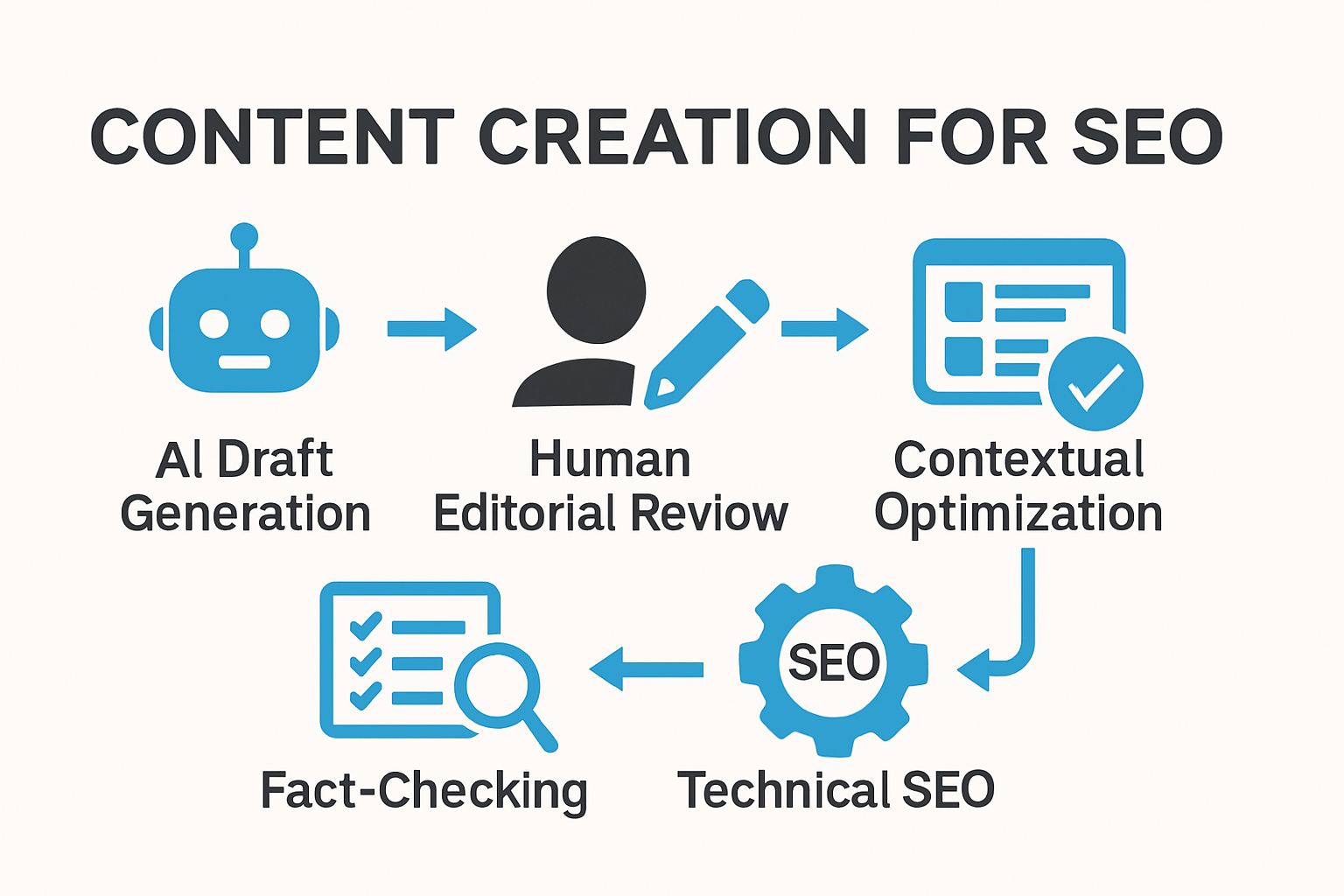
- Thoroughly reviewing and editing AI-generated drafts
- Injecting human expertise and personal insights
- Ensuring content addresses specific user search intent
- Maintaining a natural, conversational tone
- Fact-checking and verifying all generated information
AI content tools excel at generating initial drafts, research summaries, and structured outlines. However, human oversight remains crucial in transforming these raw materials into compelling, authoritative content that genuinely serves user needs and satisfies search engine ranking criteria.
The future of SEO lies not in replacing human creativity but in augmenting it. AI represents a powerful assistant that can accelerate content creation processes while allowing human professionals to focus on strategic refinement, deep analysis, and creative storytelling.
Best Practices for Optimizing AI Content
Optimizing AI-generated content for search engines requires a strategic and meticulous approach that balances technological efficiency with human expertise. Researchers from the AI Content Attribution Study emphasize the critical need for transparent content development processes and continuous quality audits to maintain search engine credibility.
Human-Guided AI Content Enhancement
AI content generation is not a set-it-and-forget-it process. Successful optimization demands active human intervention and strategic refinement. Content creators must critically evaluate AI-generated drafts, ensuring they meet rigorous quality standards and provide genuine value to readers.
Key enhancement strategies include:
- Contextual Relevance: Modify AI drafts to align precisely with target audience needs
- Tone and Voice Customization: Inject brand-specific language and personality
- Fact Verification: Cross-reference generated information with authoritative sources
- Semantic Enrichment: Add nuanced insights that demonstrate subject matter expertise
Technical SEO Considerations for AI Content
Beyond content quality, technical SEO elements play a crucial role in optimizing AI-generated materials. RankAligner’s comprehensive guide on semantic search highlights the importance of structured data and contextual comprehension in modern search algorithms.
Technical optimization strategies encompass:
- Implementing proper header structures
- Ensuring clean, semantic HTML markup
- Optimizing meta descriptions and title tags
- Creating natural internal linking strategies
- Maintaining appropriate keyword density without sacrificing readability
Advanced AI content tools now offer sophisticated features that help automatically align generated text with SEO best practices. However, human oversight remains essential to validate and refine these technical optimizations.

The most effective approach treats AI as a collaborative tool rather than a complete content solution. By combining machine efficiency with human creativity and expertise, content creators can develop compelling, search-engine-friendly materials that genuinely serve user intent and deliver meaningful information.
Balancing Human Expertise with AI Tools
The relationship between human expertise and AI tools represents a critical paradigm shift in content creation and SEO strategy. Modern professionals must recognize that AI is not a replacement for human intelligence but a powerful collaboration tool that amplifies creative and analytical capabilities.
The Complementary Nature of Human and AI Skills
AI tools excel at processing vast amounts of data, generating initial content drafts, and identifying complex patterns that might escape human perception. However, human professionals bring irreplaceable qualities such as emotional intelligence, nuanced understanding, and creative problem solving. A comprehensive study from MIT Technology Review highlights that the most effective workflows emerge when humans and AI systems work synergistically.
Key areas where human expertise remains critical include:
To provide a clear overview, the following comparison table highlights the distinct strengths humans and AI bring to the SEO content creation process. Use this table to identify the optimal blend of skills when developing your workflow.
| Area | AI Strengths | Human Strengths |
|---|---|---|
| Data Processing | Analyzing large amounts of data rapidly | Strategic interpretation of insights |
| Drafting & Structure | Fast outline and draft generation | Creative storytelling, nuanced structure |
| Factual Accuracy | Access to trained data, but may hallucinate | Fact-checking and expert verification |
| Tone & Brand Voice | Generic or basic customization | Brand-specific personality and emotion |
| SEO Technical Tasks | Automated optimization and keyword placement | Contextual SEO adaptation, relevance checks |
| Ethical & Legal Compliance | Follows rules if coded, lacks moral judgment | Ensures compliance and ethical standards |
- Strategic Interpretation: Translating data insights into actionable business strategies
- Ethical Decision Making: Ensuring content maintains moral and cultural sensitivity
- Creative Storytelling: Crafting narratives that genuinely connect with human emotions
- Complex Problem Solving: Addressing nuanced challenges requiring contextual understanding
Developing an Integrated Workflow
Successful integration of AI tools demands a structured approach that respects both technological capabilities and human creativity. RankAligner’s guide to semantic search provides insights into creating seamless workflows that maximize technological efficiency.
Effective strategies for balanced AI and human collaboration include:
- Establishing clear roles and responsibilities for AI and human team members
- Creating robust review processes that validate AI-generated content
- Training teams to leverage AI tools as intelligent assistants
- Developing continuous learning protocols that adapt to technological advancements
- Maintaining transparency about AI tool usage in content creation
Professionals who view AI as a collaborative partner rather than a competitive threat will be best positioned to innovate and excel. The future of content creation and SEO lies not in choosing between human or artificial intelligence, but in creating sophisticated, adaptive ecosystems where both can thrive and complement each other’s strengths.
Ultimately, the most successful approaches will prioritize human creativity, critical thinking, and emotional intelligence while leveraging AI’s computational power and data processing capabilities. This balanced approach ensures content remains authentic, engaging, and strategically aligned with both technological capabilities and human experience.
Common Challenges with AI Content and SEO
The integration of AI into content creation and SEO strategies presents a complex landscape of technological opportunities and significant challenges. Professionals must navigate an evolving terrain where technological capabilities intersect with search engine algorithms and content quality standards.
Algorithmic Detection and Penalties
Search engines have become increasingly sophisticated in detecting AI-generated content. Google’s recent algorithm updates demonstrate a nuanced approach to evaluating machine-generated materials, focusing on content quality rather than outright rejection. However, content that appears generic, lacks originality, or fails to provide genuine user value risks substantial ranking penalties.
Key detection challenges include:
- Pattern Recognition: Advanced algorithms can identify repetitive language patterns typical of AI generation
- Contextual Inconsistencies: Subtle logical breaks or unnatural transitions
- Lack of Genuine Expertise: Content missing deep, nuanced understanding of complex topics
Maintaining Content Authenticity and Originality
AI tools often generate content by synthesizing existing information, which creates significant risks for duplicate or derivative material. RankAligner’s comprehensive guide on semantic search emphasizes the critical importance of creating unique, contextually rich content that demonstrates genuine expertise.
Strategies to mitigate originality challenges involve:
- Extensive human editing and contextual refinement
- Incorporating original research and insights
- Developing unique perspectives on established topics
- Ensuring content reflects current industry conversations
- Adding personal experiences and professional perspectives
Ethical and Technical Compliance
Beyond technical challenges, AI content creation raises profound ethical considerations. Content creators must navigate complex terrain involving transparency, intellectual property, and authenticity. Emerging guidelines from industry organizations increasingly demand clear disclosure of AI involvement in content generation.
Critical compliance considerations include:
- Implementing robust fact-checking processes
- Maintaining transparency about AI tool usage
- Ensuring content meets professional and legal standards
- Protecting intellectual property rights
- Preventing potential misinformation
Successful navigation of these challenges requires a holistic approach that views AI as a collaborative tool rather than a complete content solution. Professionals who develop sophisticated, adaptive strategies that balance technological efficiency with human creativity will be best positioned to leverage AI effectively while maintaining high-quality, authentic content standards.
Frequently Asked Questions
How does AI-generated content impact SEO?
AI-generated content can significantly influence SEO by providing efficiencies in content production, but it may also lead to challenges such as duplicate content and lack of originality if not properly monitored and enhanced by human editors.
What are the best practices for optimizing AI content for search engines?
To optimize AI content, it’s important to review and edit drafts for quality, ensure contextual relevance, customize tone and voice, fact-check information, and maintain proper technical SEO elements like header structure and meta descriptions.
Why is human oversight essential in AI content creation?
Human oversight is crucial as it ensures content authenticity, depth, and adherence to search engine quality standards, addressing issues like potential inaccuracies and lack of unique perspectives that AI may not fully capture.
What challenges are associated with using AI content for SEO?
Challenges include algorithmic detection of low-quality or generic AI content, maintaining originality to avoid duplicate material, and addressing ethical concerns related to transparency and compliance with content creation guidelines.
Supercharge Your SEO Strategy with RankAligner
Is your team struggling to keep AI-generated content original and search-friendly? As discussed in our article, issues like duplicate content, lack of uniqueness, and missed user intent can undermine your SEO efforts and leave your site vulnerable to search engine penalties. Overcome these AI content challenges with a powerful ally trusted by top consultants and agencies.

Stop letting hidden keyword cannibalization and unnoticed duplicate content slow down your digital growth. Instantly scan your site with RankAligner, the #1 solution to uncover overlapping keywords and boost the impact of your human-guided content. Take action now. Visit https://rankaligner.com to see how easy it is to turn AI-driven drafts into results-driven, optimized pages.
Recommended
- Semantic Search Explained: Boost SEO Results in 2025
- Top SEO Ranking Factors 2025: A Guide for Consultants
- The Final Guide to Content Cannibalization in SEO (& How to Avoid)
- How to Write SEO Content: A Guide for Digital Growth|BM